

A bootlace worm can be only a few millimetres wide and still extend farther than the largest whale. Guinness World Records lists a specimen washed ashore after a severe storm at St Andrews in Fife in 1864 at more than 55 metres long, while NOAA gives the maximum length of an Antarctic blue whale as about 110 feet, or 33.5 metres.
The animal is Lineus longissimus, the bootlace worm, a marine ribbon worm in the phylum Nemertea. A Marine Life Information Network species account puts its usual length at 5 to 15 metres, with individuals exceeding 30 metres, while its body is normally only about 5 millimetres wide.
The 55-metre record comes with an asterisk
The Victorian measurement is extraordinary, but it should not be read as the normal size of the species. The 1864 St Andrews animal remains the famous extreme case.
Ribbon worms are exceptionally elastic, and that makes length unusually difficult to standardise. The Guardian’s August 2026 profile of the species notes both the 55-metre record and the longstanding objection that the specimen may have been stretched during measurement.
Even without the disputed extreme, a bootlace worm longer than 30 metres would rival the biggest animals on Earth in linear dimension. What it does not rival is a blue whale in mass: the worm is a slender ribbon of soft tissue rather than a 100-tonne mammal.
That distinction matters. Guinness describes Lineus longissimus as the record holder for the longest solitary animal, but the number attached to that record is a historical measurement of an unusually extensible body.
The slime contains a potent peptide toxin
The worm’s other startling feature is its mucus. When disturbed, Lineus longissimus produces large amounts of thick secretion, and marine reference works describe the smell as pungent.
In 2018, researchers reported a family of peptide toxins in that mucus called alpha-nemertides. Their study in Scientific Reports identified nemertide α-1 as a particularly potent toxin acting on voltage-gated sodium channels.
The experiment did not involve one giant Scottish worm being squeezed into a beaker. Living specimens were collected off the west coast of Sweden, mucus was gathered after the animals were gently provoked, and α-1 was isolated and also synthesized for laboratory testing.
Injected into green crabs, α-1 produced paralysis from doses of 1 microgram per kilogram and death at higher doses. In a complementary experiment involving 50 juvenile Blaptica dubia cockroaches, every animal receiving more than 7.1 micrograms per kilogram was dead or permanently paralysed after 24 hours.
The peptide was much more potent against the invertebrate sodium channels tested than against the mammalian channels in the same study. The researchers reported roughly 100-fold selectivity for insect channels over the tested mammalian channels, which is more precise than saying mammals or humans are simply unaffected.
That selectivity is why the molecule attracted attention as a possible starting point for pest control. A University of Queensland account of the research stressed that considerable work remained before the peptide could become an insecticidal product.
The idea sits alongside other attempts to replace broad chemical treatments with more targeted biology. Silicon Canals has previously covered SOLASTA Bio’s peptide-based insect-control work and Biocentis’ programmable approach to insect populations.
How a ribbon worm hunts
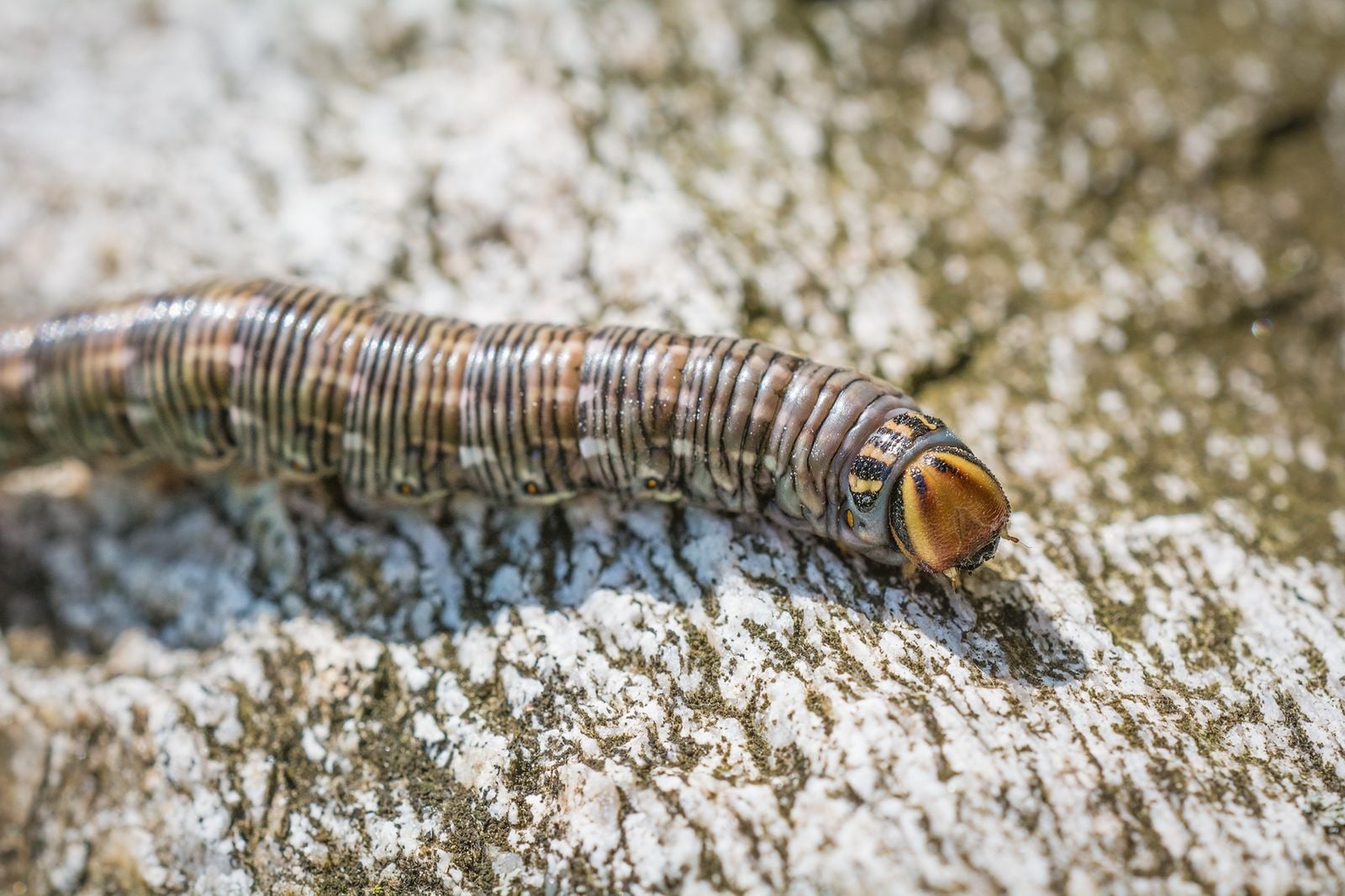
Bootlace worms are predators, and annelid worms are among their prey. They do not need jaws or claws to capture them.
The defining tool of a nemertean is its eversible proboscis, a muscular structure stored inside the body and rapidly turned outward when the animal attacks. An University of California Museum of Paleontology overview describes how nemerteans use the proboscis to wrap around or immobilise small invertebrate prey.
Some ribbon worms carry a piercing stylet on that organ. Lineus longissimus belongs to a group with an unarmed proboscis, so the original draft’s implication that this species might deploy a calcified barb was misleading.
It is also not an eyeless animal. The MarLIN description records rows of as many as 20 deeply set reddish-brown or black eyes on each side of the snout, although those eyes can be difficult to see against the worm’s dark body.
Nemerteans as a group are widespread marine predators, with roughly 1,300 species discussed in the 2018 toxin paper. The bootlace worm itself occurs around European Atlantic, North Sea and Baltic coasts, where it can lie coiled beneath boulders, in rock pools and among kelp holdfasts.
One ribbon worm has lived for decades
The extreme length of Lineus longissimus raises another question that biologists have barely been able to answer: how long do ribbon worms live?
They offer few convenient clocks. Their soft bodies lack the shells, bones or obvious growth rings that researchers use to estimate age in many other animals.
A captive ribbon worm called Baseodiscus the Eldest, or B, finally supplied one hard data point. A study by Chloe Goodsell, Parker Jung, Svetlana Maslakova and Jonathan Allen identified B as Baseodiscus punnetti and reported that the animal had been maintained in aquaria for at least 26 years.
The history behind that number is unusually well documented. According to William & Mary, Jonathan Allen took custody of the worm in 2005 after it had already been collected as an adult in the late 1990s, and genetic work later established its species.
That makes B the oldest ribbon worm yet documented, not proof that every nemertean lives for decades. It does show that at least one member of this poorly studied group can persist far longer than earlier captive observations suggested.
Why length is hard to measure
A ribbon worm does not have one rigid length in the way a whale skeleton does. Its muscular, soft body changes shape dramatically as it contracts, crawls and extends.
That is why modern species accounts distinguish between ordinary measurements and the famous Victorian record. Most Lineus longissimus encountered by biologists are nowhere near 55 metres.
The sensible version of the claim is therefore narrower and stranger: one bootlace worm washed ashore in Scotland was recorded at more than 55 metres, while the species normally measures far less and is elastic enough that the record has been questioned ever since.
A predator hidden in the wrack line
Along British and Irish coasts, Lineus longissimus can live on the lower shore beneath boulders, in muddy sand, in rock fissures and tangled through kelp. A contracted individual can look less like a record-breaking animal than a dark knot of wet cord.
In August 2026, that combination of size, elasticity and toxic mucus put the species on The Guardian’s shortlist for Invertebrate of the Year. The attention was unusual for an animal that normally spends its life folded into the overlooked spaces of a cold shoreline.
That is where the fact is most striking. Somewhere under a boulder or among the kelp, a ribbon only millimetres across can loosen into metres of dark, glistening tissue, carrying in its mucus a peptide potent enough to lock the muscles of a crab — and, in one storm-tossed Scottish specimen, a body once measured beyond the length of any blue whale.