
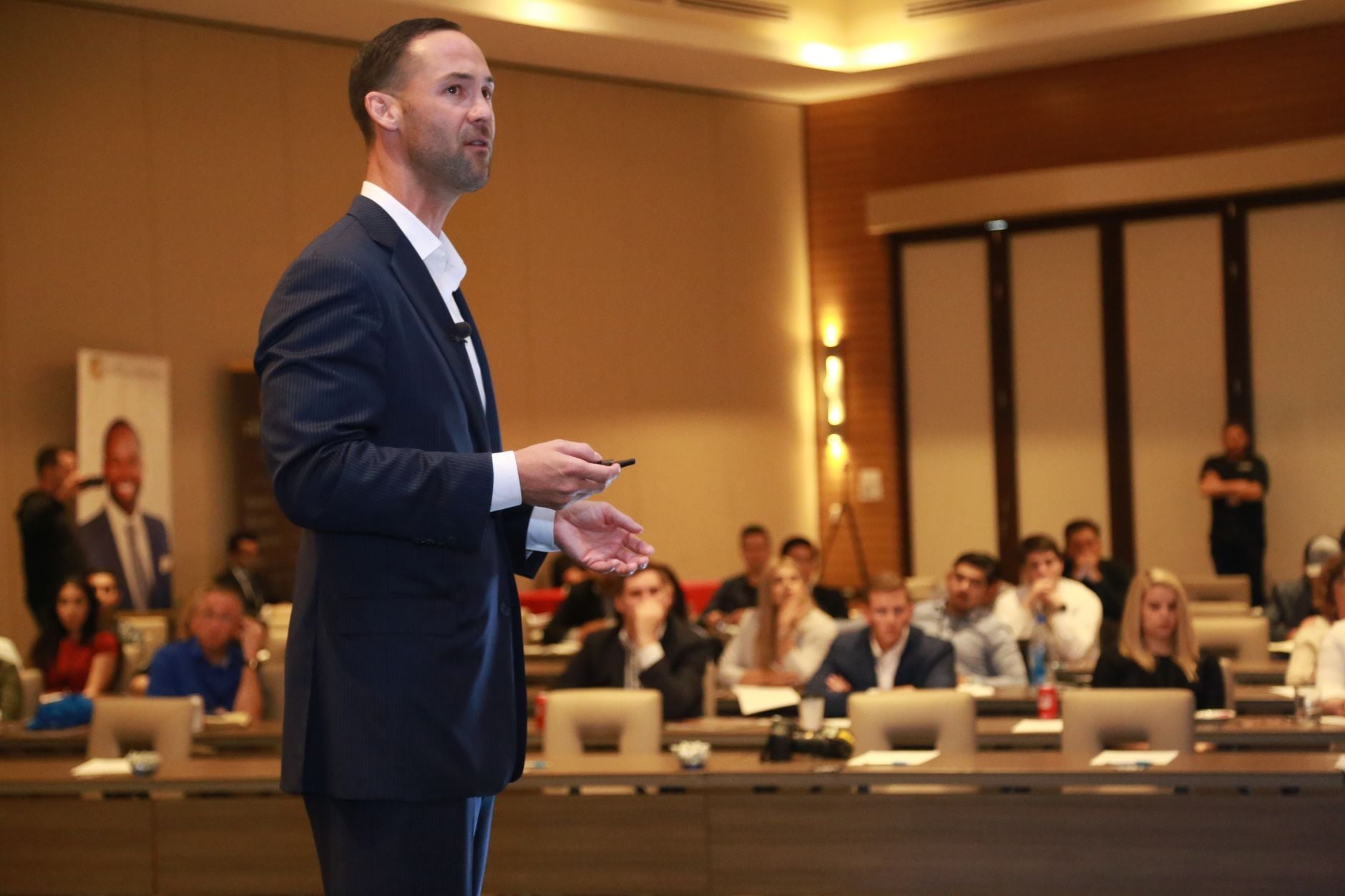
Public speaking creates a peculiar problem for the hands. Leave them hanging at the sides and the body can seem disconnected from the words. Move them too deliberately and the audience may start watching the performance instead of following the idea.
An older TED Talk analysis supplied a number that travelled widely through presentation advice: highly viewed speakers averaged 465 hand gestures in 18 minutes, compared with 272 among less viewed speakers. It is exactly the kind of result that invites a terrible conclusion, namely that a nervous presenter should start counting.
A paper first published online in 2025 offers a much better interpretation. The useful ingredient may not be movement alone. It may be whether the hands create a visual version of what the speaker means.
This is one new paper, not settled consensus. Its large TED analysis is observational and cannot establish that gestures made a talk popular. Two preregistered experiments, however, allowed the researchers to test their proposed explanation under controlled conditions.
The famous 465-versus-272 comparison needs the right label
Behaviour researcher Vanessa Van Edwards has described an analysis in which 760 volunteers evaluated TED Talks released in 2010. As she told Toastmasters, the highest-viewed talks averaged 465 gestures during an 18-minute presentation, while the lowest-viewed averaged 272. She also observed that stronger speakers often used congruent movements, such as widening their hands while describing something large.
The figures are memorable, but they are not the result of a peer-reviewed randomised experiment. “Popular” meant viewed more often, not objectively clearer or more persuasive. Topic, speaker fame, timing, promotion, production and the idea itself can all help a talk travel. The comparison never showed that adding 193 hand movements would deliver another seven million views.
Its value was descriptive. Speakers who attracted much larger audiences appeared to move their hands more, and perhaps to use those movements more purposefully. The newer research separates those two possibilities.
The 2025 paper tracked movement across 2,184 talks
Giovanni Luca Cascio Rizzo, Jonah Berger and Mi Zhou assembled 2,184 TED videos from 1,857 speakers, recorded between 2006 and 2017. They excluded performances and talks involving multiple speakers so that movement could be assigned more cleanly to one person.
Their paper in the Journal of Marketing Research used automated video analysis to measure hand movement and compared it with likes. The models accounted for a long list of speaker, speech, video and talk characteristics, including occupation, gender, topic, language, vocal features, facial expressions, video length, visual properties and time effects.
More movement was associated with more positive response. In the adjusted model, doubling hand movement was associated with a 5.18 per cent increase in likes, equivalent to 798 additional likes on average. Comments also tended to be more favourable.
Those controls make the finding harder to dismiss, but they do not turn it into causation. An experienced, confident speaker may both gesture more and deliver a better talk. Some unmeasured feature of the person, material or audience could contribute to both. The field result says the variables travelled together.
The revealing distinction was motion versus meaning
The researchers then cut the talks into almost 200,000 ten-second segments and used a large multimodal model to consider the hand movement alongside the transcript. Human-written coding rules divided the movements into three useful types.
An illustrator visually represents meaning. A speaker might trace a rising line while discussing growth, hold two hands apart to show size or mimic interlocking gears while describing a system. A highlighter draws attention without depicting the idea, such as pointing at a bottle while naming it. Unrelated movement included actions such as adjusting glasses or scratching an itch.
That classification is the heart of the study. Talks with more illustrator gestures received more likes. Highlighters and unrelated movements did not show the same positive association. Simply making the frame busier was not enough. The useful movement was semantically connected to the sentence.
The model-based labelling deserves caution. The team developed the system with human annotators and validation checks, but nearly 200,000 clips were not all judged independently by people. The scale came from automation, and the evidence inherits both its reach and its measurement limits.
Two experiments held the words still and changed the hands
To move beyond correlation, the researchers ran two preregistered experiments with US participants recruited through Prolific.
In the first, 685 people watched an 11-second pitch for a skincare product. The script, voice and recording length stayed the same. A trained speaker either made one illustrative gesture, a highlighter, an unrelated movement or no movement. While saying “just spread it on your face”, for example, the illustrator mimed spreading; the highlighter pointed at the face.
The illustrative version made the content easier to understand. On the study’s seven-point scale, it averaged 6.37 for understandability, compared with 6.02 for the highlighter, 5.75 for unrelated movement and 5.79 for no movement. Perceived competence followed the same pattern: 5.34 for the illustrator, against 4.94, 4.84 and 4.79.
A second experiment with 892 participants extended the design across pitches for a skincare cream, a language-learning app and a water-filtration system. Illustrators again produced higher persuasion ratings than all three alternatives. The researchers examined attention, caring, extraversion, genuineness and several other possible explanations. Making the message easier to understand, which then raised perceived competence, was the only proposed process that accounted for the advantage against every comparison. Some of the indirect estimates in this second experiment were marginal, so the mechanism is supported rather than finally settled.
This is an audience inference, not a certificate of knowledge. A movement that clarifies an explanation can make the speaker appear more competent. It does not guarantee that the explanation is true.
Independent research supports the comprehension link
The paper’s mechanism sits beside a much older literature about gesture and understanding. A 2011 meta-analysis of 63 samples found a moderate benefit when listeners received speech with gestures rather than speech alone. The benefit was larger for movements depicting motor actions and when gestures contributed information that was not completely redundant with the words.
A 2019 meta-analysis covering 83 independent samples also found a moderate benefit to comprehension when learners produced or observed gestures. The effect varied with the gesture’s type and function, the information it supplied, the learner’s age and the way understanding was measured.
Those reviews did not test virality, likes or product pitches. Their outcomes concerned comprehension and learning, so they cannot independently confirm every marketing claim in the new paper. They do support the narrower premise that hands can carry information rather than merely decorate speech.
The useful lesson is not a gesture quota
Nothing here turns 465 into a target. The older comparison described talks that had already succeeded or failed to attract views. The newer experiments used one carefully controlled movement in a very short pitch. Neither study asked a speaker to fill every pause with motion.
The more useful distinction is between a diagram and decoration. When hands show how two parts fit, trace a direction or give scale to an object, they supply another representation of the sentence. Repetitive movement on every stressed word may add activity without adding information.
This boundary matters at work, where presentation coaching can easily become theatre. I have written before about what can happen when trying to impress becomes visible as a performance. A memorised catalogue of “power gestures” risks producing the same problem. The hand should clarify the thought, not announce that the speaker has studied body language.
There are further limits. TED speakers work on stages with professional framing and unusually polished material. Gesture conventions differ among people and cultures, and not every speaker has the same range of movement. An average audience response should not become a narrow rule for what competence is supposed to look like.
The strongest conclusion is smaller and more interesting than “talk with your hands”. Audiences do not appear to reward hands merely for being busy. They respond when movement helps the words become visible.